
From Chatbot to Conversational Partner: How unframe Is Bringing AI Avatars into Everyday Life
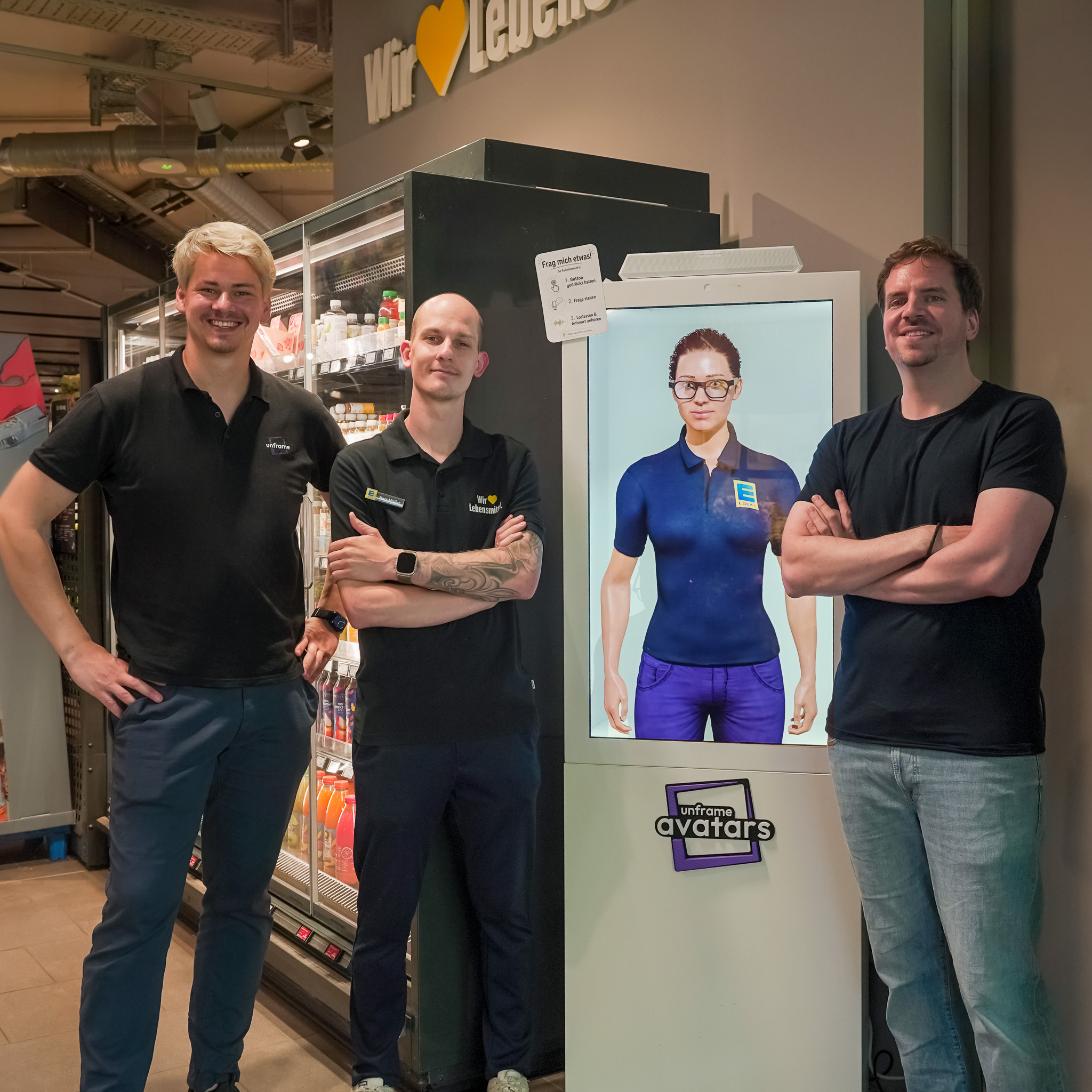
Where can I find the oat milk? What could I cook today? And what’s on offer right now? For two weeks, customers at EDEKA Müller in Babelsberg could ask these questions not only to supermarket staff, but also to Jana, an AI avatar developed by Potsdam-based startup unframe. The young company is bringing AI to places where people naturally ask questions: right into everyday life.
For unframe, the local supermarket deployment is first and foremost a real-world test: How do people react to a visible AI counterpart? What kind of information do they expect? And how does the interaction need to be designed so that it feels intuitive? The insights feed directly into the further development of the company’s product, “unframe avatars”.
We spoke with founders Tim, Maximilian and Sebastian about the EDEKA pilot, personalised interfaces and where AI avatars can create genuine added value — as well as why direct contact with users is so important when developing their technology.
MTH: Hi Tim, Maximilian and Sebastian! It’s not every day that we come across an AI startup from our network while grocery shopping — and yet unframe recently appeared at the EDEKA supermarket in Babelsberg. What exactly were you doing there, and how did the collaboration come about?
Sebastian: At EDEKA in Babelsberg, we spent two weeks testing how our avatar Jana would be used in a normal shopping environment. Jana was displayed in a Holobox, greeted customers and answered questions such as: Where can I find a particular product? What could I cook today? What are the current special offers? In doing so, the avatar also takes some of the recurring everyday questions off the staff’s shoulders.
The collaboration came about through Tilo Schneider’s “Mission is Possible” event. That’s where we met Randy Müller from the EDEKA supermarket, and we quickly came up with the idea of simply trying the avatar out together on site.
For us, that’s particularly valuable because we’re not just talking theoretically about possible applications. We can see directly how people react to the avatar, what they ask and what we still need to improve. That kind of honest feedback from a real-life setting helps us enormously.
MTH: And how exactly are customers reacting? Have you received any initial feedback?
Tim: Yes, and the reactions are actually very varied. We see, for example, that many people speak to Jana quite naturally. Some ask where a particular product is located or how long the supermarket is open. Others want to know which chocolate Jana would recommend. So you end up with completely normal conversations — and sometimes some surprising ones too.
A lot of people are particularly interested in the multilingual capabilities. The EDEKA staff also immediately started testing how many languages they could use to talk to the avatar, including German, English, French, Vietnamese, Arabic and Kurdish.
But we’re also learning what still needs to improve. A busy supermarket can be quite noisy, so the avatar isn’t always easy for everyone to understand. That’s particularly important for older people. We’re therefore working on subtitles so that users will also be able to read the avatar’s responses in future. We’ve also adjusted its appearance slightly following initial feedback to make it seem friendlier. The good thing is that we can make changes like these directly through our platform and test them on site straight away.
MTH: For people who aren’t familiar with your technology yet: Apart from the visible character, what distinguishes your AI avatars from a conventional chatbot on a website?
Sebastian: The difference becomes very clear in a supermarket. There is a visible point of contact. You don’t first have to understand how a technical system works or figure out where to click. You simply ask a question, just as you would ask another person.
We see the same thing on websites and in apps. A conventional chat interface can initially feel anonymous and technical to many people. An avatar makes the exchange more personal and lowers the barrier to interaction. You can speak to it directly, but you can also type if that’s what you prefer.
For us, the key difference therefore isn’t just the animation. The avatar immediately makes one thing clear: I can start a conversation here and get an answer to my specific question.
MTH: Could you briefly walk us through a typical interaction with one of your avatars? What kind of questions could I ask, and where does its remit end?
Tim: At the EDEKA supermarket, for example, I could ask where the oat milk is, what kind of dish I could make with certain ingredients, or what the current special offers are. The avatar will then either respond based on its general knowledge base or search its database for relevant information when it receives a specific request.
Before an avatar is deployed, you define exactly what it knows, how it behaves and how it communicates. So you retain control over the data being used. That makes it possible to cover a wide range of applications, whether in retail, a museum or a university.
If a question falls outside its area of responsibility, the avatar should say so openly and, in the supermarket example, direct the customer to a member of staff instead. The aim is to make the most of AI’s strengths while providing reliable assistance within each specific application.
MTH: Poor or inadequate customer service remains a stumbling block for many companies. What advantages can visual AI assistants offer here? Do we actually need this kind of visible counterpart?
Sebastian: From our perspective, the big trend isn’t just AI as a technology — it’s the personalisation of interfaces. Until now, everyone has generally received the same information, whether through a poster, a notice board or a digital display. An avatar turns that principle around: instead of searching for the information that is relevant to me, I ask my own question and receive an answer tailored to that specific request.
Tim: And what really matters is how simple it feels. We come from an interaction design background and have spent a long time looking at how people can intuitively understand new technologies. A visible counterpart uses a pattern everyone already knows: I talk to someone and they respond. That immediately makes it clear that information isn’t simply being displayed — an actual exchange is possible.
Does that always require an avatar? No, of course not. But wherever people are looking for guidance, have questions or don’t want to first learn how to use a technology, this kind of counterpart can make a real difference.
MTH: You’re currently a three-person founding team. Where did you originally meet, and when did the idea for unframe first emerge?
Tim: Sebastian and I have known each other since our time studying at the University of Applied Sciences Potsdam. After completing our Master’s degrees, we ran the university’s Interaction Design Lab together. Working with students, we spent a lot of time exploring future-oriented technologies such as XR and thinking about what new forms of interaction might look like.
Sebastian: At some point, a question naturally emerged: What happens if we take these ideas out of a research environment and put them into practice? We wanted to find out whether we could create something that genuinely helps people in everyday life. That’s when we decided to found unframe.
The two of us cover technology and design very well, but to create a balanced team we were still missing the business side of the company. With Maximilian, we found someone who complements us perfectly in exactly that area.
MTH: You officially joined the MTH Accelerator in April 2026. Where is the programme helping you most at the moment?
Tim: For us, one of the most valuable aspects is being able to speak directly with people who have a lot of experience working with startups. During the workshops and one-to-one sessions, the experts work with us in a very practical way. They look at our materials and our customer communication and work through how we can improve our sales process together with us.
As I mentioned, our background is in user-centred design and interaction design. What we still lack is the experience of communicating that value just as clearly to the outside world and turning it into an effective sales process. That’s where we’re receiving a lot of very practical support. And, of course, we also really value the exchange with other founders.
MTH: What are the next steps for your startup, and what do you have planned for the coming year?
Sebastian: One important next step for us is to make a clearer decision about which target groups and applications we want to focus on initially. Our platform has deliberately been built to be very flexible, but that breadth also makes it more difficult to position clearly in the market.
The EDEKA pilot showed us just how valuable direct interaction on site can be. As soon as people experience the avatar themselves, new ideas, contacts and concrete enquiries emerge very quickly. We want to expand these kinds of real-world deployments over the coming year. At the same time, these experiences help us better understand where our platform can create the greatest value.
Our goal is to become the European platform for secure and controllable AI communication. Avatars are a central part of that vision for us because they provide a personal and intuitive way of accessing AI. But it’s not just about the technology. Above all, we’re interested in how interactions between people and AI can be designed in a way that is understandable, trustworthy and genuinely effective.
MTH: Tim, Maximilian and Sebastian — thank you very much for speaking with us!