
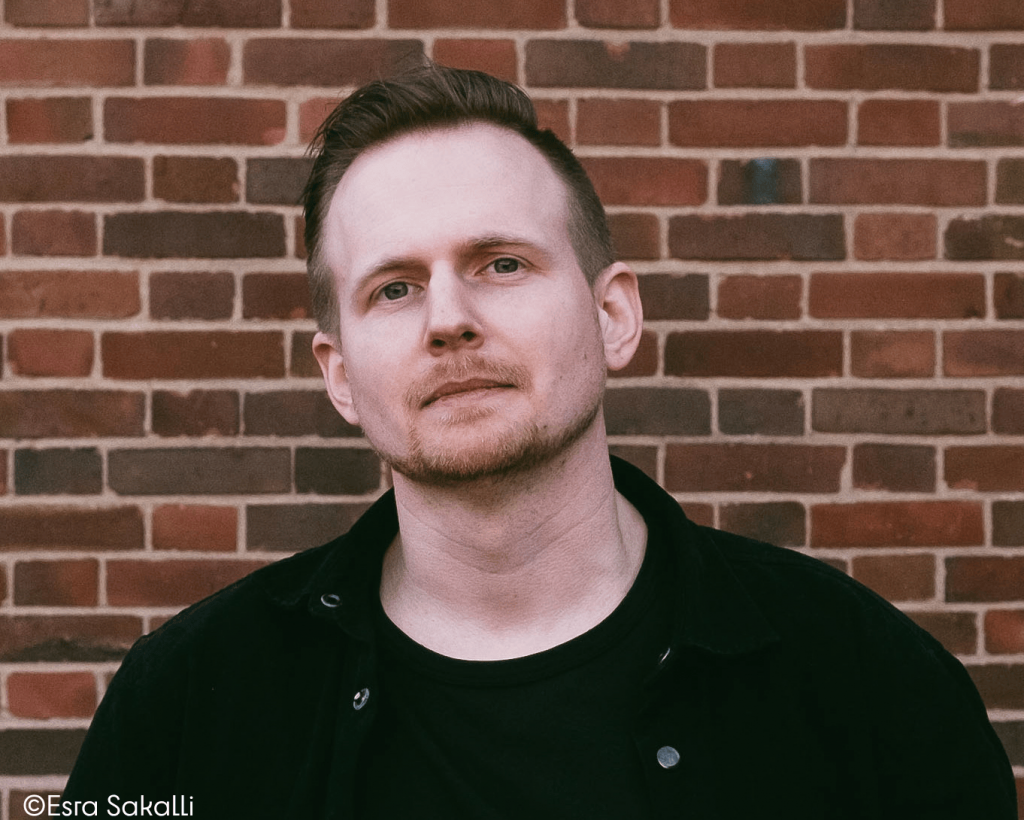
Positioned at the intersection of tech transformation and film tradition, the startup Arkanum Pictures has established itself as one of the most exciting players in Babelsberg today. Appearances at the Berlinale and the international Series Mana Festival in Lille demonstrate that the young production company, led by founders Sebastian Herbst and Lukas Koll, has already carved out a niche for itself in the media industry. Behind this success lies an innovative approach: Arkanum Pictures combines traditional production craftsmanship with disruptive technological innovation. Through virtual production (VP) and the use of AI in partially collaborative formats, they are creating new possibilities for storytelling.
We spoke with co-founder Sebastian Herbst about personal milestones and his work on the long-running series GZSZ—as well as the artistic limits of virtual production.
MTH Potsdam: Hi Sebastian! It’s been over two years since Arkanum Pictures was founded—a lot has happened in the meantime. What has changed for you as a startup?
Sebastian Herbst: I think we’ve made our mark in Babelsberg. One of our goals as an innovative production company has always been to build a network in the area and become a key player in bold projects. We’ve succeeded in doing that. We are in constant dialogue with Studio Babelsberg, other local partners such as ROTOR, Lavalabs, the MTH, and, of course, the Film University as a talent incubator. As producers and creatives with a progressive mindset and technological expertise, we bring a dimension to this ecosystem that—in our view—has been missing until now. Of course, we are still at the beginning of our journey and aim to take on many more projects, and above all, larger ones.
MTH Potsdam: Some of your employees actually retain the rights to the productions they oversee. This means you took an unconventional approach for the industry from the very beginning. Does it still work?
Sebastian Herbst: Yes, that’s another pillar of our company. This approach allows us to welcome young producers who want to bring their first major productions to life, and we’re constantly learning from one another in the process. Thanks to this structure, we have a strong presence both nationally and internationally and are able to grow at a healthy pace—which is no small feat given the current market conditions.
MTH Potsdam: Let’s talk about France: You recently pitched your series “Ignition” at the co-production pitching session during the Series Mania Festival in Lille. How did the event go for you?
Sebastian Herbst: The invitation itself was a tremendous honor for us. We are one of 15 projects selected from over 400 submissions from around the world, putting us on the most prominent stage at Europe’s largest TV series industry event. After the pitch, we spoke with many potential partners for the project, most notably the major world sales companies that could potentially sell the series internationally. For us as a still-small company, such contacts are incredibly valuable. It’s great to get to know each other in person in a setting like this and to receive the festival’s “stamp” at the same time. In any case, I have a few follow-ups to write and plenty to do in the coming weeks.
MTH Potsdam: … The festival is considered a staple among European filmmakers. How do you prepare for a pitch like this?
Sebastian Herbst: The Co-Pro Pitch is considered the “centerpiece” of the forum and takes place in the largest hall in front of an audience of 800 people. The festival itself places a strong emphasis on professionalism. We received several pitch training sessions and rehearsed extensively. This process also helps you get to know your own project even better and identify any areas that need refinement. So, practice, practice, practice.
MTH Potsdam: Did participating in the international networking initiative help you?
Sebastian Herbst: Yes, the festival has helped us build a stronger network both internationally and nationally—though true networking really gains significance through consistency. We’ll meet the potential partners we’ve just gotten to know again in Cannes, Venice, at the Berlinale, or next year at Series Mania. Since we were also part of the Seriesly delegation trip, our smaller group from Berlin-Brandenburg was supported by the Medienboard Berlin-Brandenburg. We’ve gotten to know each other better now and are staying in touch.
MTH Potsdam: In the past, technological innovation has sometimes been viewed with skepticism in the film industry. Do you feel like the industry is starting to embrace it again?
Sebastian Herbst: I don’t think there’s a clear-cut answer. On the one hand, current innovations in AI are opening up new possibilities for simplifying existing, very laborious work processes. This would allow us, as Europeans, to take on larger projects as well. So far, however, this is hardly happening. It is interesting, though, that the historically precarious working environment of “media production” seems to be getting even tougher with the rise of AI. Just recently, the closure of Pixomondo was announced. This shock is symptomatic of the entire VFX industry and is a major cause for concern for me. It could lead to a massive brain drain if we lose all these talented individuals to other fields that have nothing to do with media production—simply because there are no longer any jobs for them. In that sense, I believe that there isn’t really “the industry” here, but rather a great many different voices, each with a very different perspective on the issue. My personal prediction is that AI will soon give rise to business models that compete with traditional media production and are operated by other players like Google or ByteDance themselves. The exciting question is whether the audience will embrace this. The Chinese TikTok series featuring dogs in historical costumes give us a clue.
MTH Potsdam: You were founded in Potsdam Babelsberg and are part of the MediaTech Hub Potsdam network. Is the location still an advantage for you?
Sebastian Herbst: Yes, the location remains important to us. Within a one-kilometer radius of here, we have an incredible concentration of expertise, talent, and history. We believe there is still so much potential to be tapped into.
MTH Potsdam: With “GZSZ goes VP”—a pilot project by UFA Serial—you’ve recently been serving as a test case for a true series veteran. How did this come about, and what’s it like working on the show?
Sebastian Herbst: The project emerged from lengthy discussions and deliberations among the various partners. GZSZ has always been an incredibly innovative format, especially in terms of its processes. It’s like a well-oiled machine where no cog is superfluous. That’s impressive, but it has natural limits in terms of what’s feasible and can be implemented in day-to-day production. So it’s only natural to wonder what modern technologies could make possible with a format like this. Working on this project was a blast for us! We were able to apply our expertise in virtual production “on a budget,” build stronger connections with various partners like Lavalabs, ICT, and Studio Babelsberg—and, of course, UFA—and at the same time, we learned an incredible amount ourselves.
MTH Potsdam: Do you still see a lot of untapped potential for virtual production in traditional film and television formats—and do you see any artistic limitations to its use?
Sebastian Herbst: Of course, there are artistic limitations, and virtual production is by no means a magic bullet for every production problem. There are use cases where it makes a lot of sense, and others where it simply doesn’t fit. When I turn on the TV or open my media library, I already see a wide range of possibilities—especially in long-running formats with moderate budgets, there’s still an incredible amount of potential to be tapped. And, of course, virtual production can also open the door to entirely new projects that previously seemed impossible or unthinkable. Why not try a weekly show set on Mars or a mockumentary in a diving station? It’s a matter of weighing the pros and cons on a case-by-case basis. But that’s exactly where we come in with our expertise and workflow consulting. With virtual production, you always have to think from the project’s perspective. If it doesn’t make sense, we’d say so openly; otherwise, very soon no one would consider us as a partner anymore.
MTH Potsdam: You were part of the MediaTech Hub Accelerator. Did you take away any specific insights from that experience?
Sebastian Herbst: For us, networking with our partners at the location was particularly important. As a media company, we operate differently from many other startups in the accelerator, since we don’t rely on traditional investment funding.
MTH Potsdam: If everything goes according to plan, what milestones can Arkanum Pictures expect in the coming years?
Sebastian Herbst: In addition to the IGNITION series, of course, we’re producing more feature films. That remains a key part of our profile. We want to take on larger and more international projects—either as majority producers or as minority co-producers. We also currently have three immersive experiences in production.
MTH Potsdam: What advice would you give to entrepreneurs looking to establish themselves in the media industry?
Sebastian Herbst: I know that the mood isn’t very good right now, and I often feel the impact of the industry’s situation myself. To quote Rebecca Solnit: “Every crisis is in part a storytelling crisis.” The quote suggests that a crisis can only be overcome when we stop telling ourselves stories of denial or hopelessness. The way we talk about a problem plays a decisive role in whether we can solve it.
As strange as it may sound, I believe that now is not a bad time to start a business—even if the market seems to suggest otherwise. The key is simply to be creative—not just within projects, but also within business models. Right now, the media industry needs creative and smart people who want to do things differently and better. Especially when it comes to our democracy, I believe that companies that question the status quo are incredibly valuable. There is a huge need for talented media professionals and new narratives.
MTH Potsdam: Sebastian, thanks for talking with me.