
Is Journalism Dead? A Conversation with BotTalk About the Attention Economy and AI Audio for Publishers
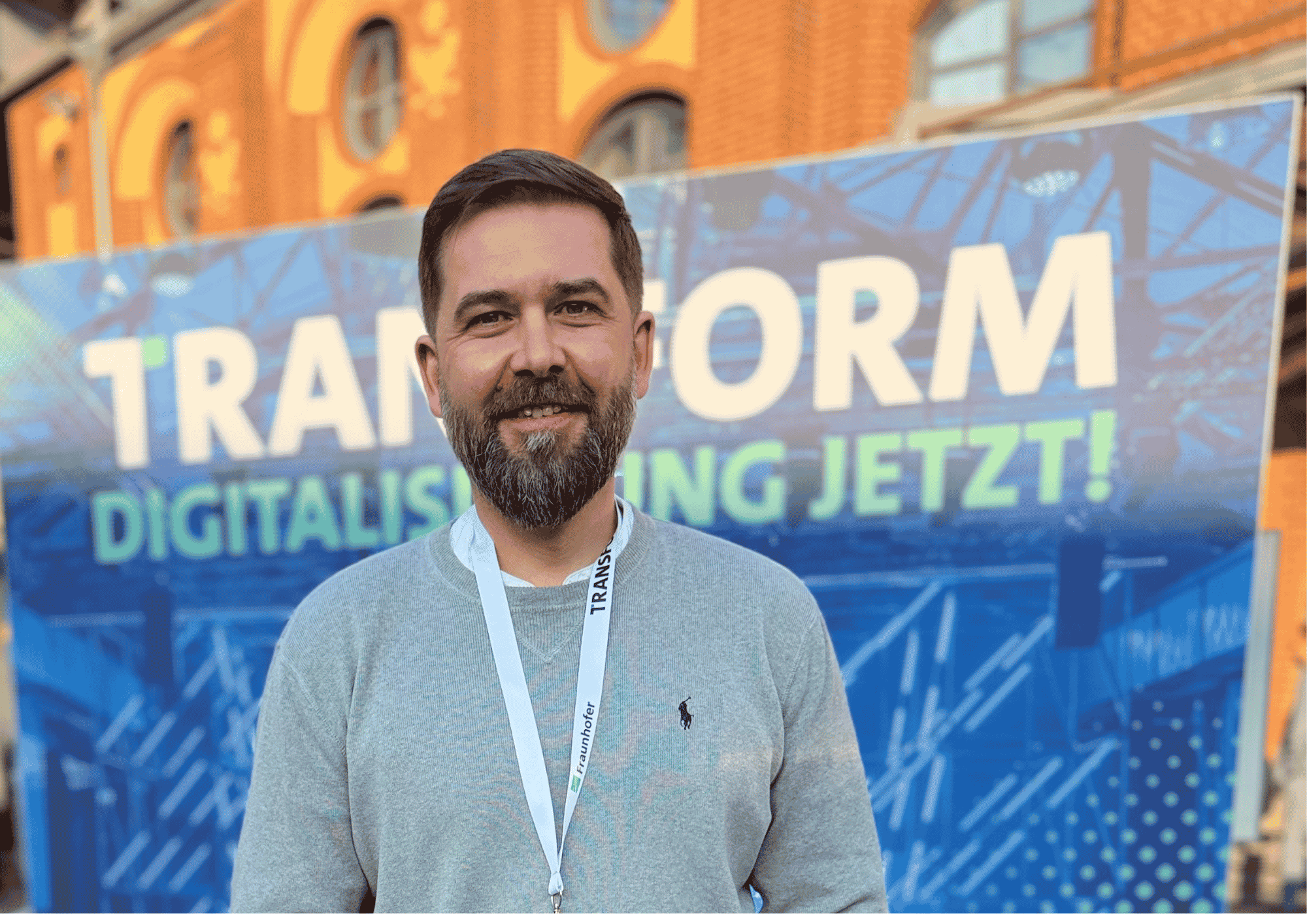
Fewer and fewer people read journalistic texts. For news media, text is a double challenge, because fewer paying readers also means fewer paying advertisers. BotTalk, winner of the MTH Startup Demo Day 2026, offers newsrooms an alternative in audio form: The Hamburg-based team provides publishers with the infrastructure to automatically convert articles into audio content, including with the help of AI-cloned newsroom voices. More than 30 publishers are already customers, including taz.
We spoke with founder Andrey Esaulov and COO Josephin Peuten about the attention economy, cloning editors, and their morning routines for news consumption.
MTH: Hi, Andrey and Josephin! What’s your personal comfort medium in the morning: radio, a podcast, or a good daily newspaper?
[Josephin]: It’s different every day for me. Sometimes it’s just a chatty podcast while I brush my teeth, sometimes it’s my favorite playlist at breakfast. I only listen to the radio in the car.
[Andrey]: A news podcast on YouTube playing in the background while I make coffee. To be honest, I’m an extreme case: I get about eight hours of audio a day. Maybe that also explains a little why I founded BotTalk.
MTH: In September, you came out on top at our Startup Demo Day 2026 after convincing a jury of investors and media professionals. How did you experience the event, and what has changed at BotTalk in the meantime?
[Josephin]: I had a lot of fun as a participant. Through the networking across different industries, I got a glimpse into a world that was completely new to me: the film industry. It’s really wild what’s possible there these days, and what ideas the other startups are developing. With our audio player for publishers, we still fit right in, and the exchange with other startups and investors was very interesting. What has changed for us? Not that much at first. We’re currently working toward two big trade shows and toward our goal of adding another zero to our roughly 30 publisher customers!
[Andrey]: For me, the Demo Day was a first: For the first time, I didn’t pitch on stage myself. As a founder, that feels pretty unfamiliar, and I stepped well outside my comfort zone. It was still the right decision. In preparing with Josi, we had to take our pitch completely apart and question everything. I’m extremely happy with the result. It was our best pitch yet. Without me.
MTH: Among other things, you describe your startup as an “audio control layer” for newsrooms. What does that mean in concrete terms, and how would you describe your business model to traditional media professionals?
[Josephin]: We make sure that you can generate great audio for your texts and articles with little effort. From A for automation rules – for example, when every article in the sports section should be read by the same voice, but the articles in the news feed by a different one – to Z for future. With our player, publishers reach loyal customers and new listeners instead of readers, without having to build anything themselves or needing the technical know-how in-house.
[Andrey]: A newsroom is an extremely controlled environment. And it has to be. The world outside is chaotic enough, so in a newsroom everything is checked, proofread, corrected. Now imagine you build AI into your articles. Out of 200 articles a day, 199 are fine, but in the one important article somewhere in the middle, the model starts to hallucinate: It suddenly screams, sings, invents numbers. That’s not a horror scenario, that’s everyday life with these models. That’s exactly what the control layer is for. It’s a group of AI agents that listen to every piece of AI audio, correct it, and flag whatever can’t be fixed automatically. The control layer is your editor-in-chief, just for AI.
MTH: When it comes to the attention economy, you make a provocative claim: journalism is dead. What exactly do you base that on, and what should newsrooms change?
[Josephin]: Clearly, their formats! Nobody sits down and scrolls through long news articles on a smartphone, tablet, or laptop. Older readers use print and, in our experience, are willing to switch to audio because it’s more accessible. Younger people are so used to the podcast medium that the switch to news audio isn’t a problem for them either.
[Andrey]: Journalism is dead in the attention economy. On the screen, I mean. Text will never be as seductive as a Reel. And anyone who has watched enough Reels is very unlikely to read a longer text anymore. That’s a global problem, and BotTalk can’t solve it. But we can give publishers a chance. The moment the user puts the phone down, audio keeps playing in the background. A long story has room again there, and the attention is still there. What should newsrooms change? Stop fighting for the screen with text. They’ve lost that fight. Our ears are still free.
MTH: Media companies and publishers depend on Google, Meta, and AI providers for reach. What role does audio content play in this tension?
[Andrey]: Podcasts are booming, and demand is still much greater than supply. But above all, audio is the one channel where publishers still speak directly to their readers. Between a search result and the article stands Google. Between a post and the article stands Meta. Between the audio on your own site and the listener, nobody stands. Even in the podcast player, it’s still a direct connection, and with it, direct loyalty. Publishers have handed that relationship over to the platforms piece by piece on the screen. In the ear, it still belongs to them.
MTH: Among other projects, you supported an audio rollout for the daily newspaper taz and cloned the voices of its journalists. How exactly did that work?
[Andrey]: Cloning is an iterative process. Ideally, the journalist reads their own texts aloud – about two hours of material in a controlled environment like a podcast studio. Small tip: It works surprisingly well in a car, because the interior is acoustically almost perfect. With this material, we clone the voice on the ElevenLabs model; we’re their official partner in Germany. After that, we keep fine-tuning until the clone truly sounds like the original. Only then does the voice go live and read the articles. And 70 percent of taz app users say their most important use case is now listening, not reading.
MTH: In projects like this, have you also encountered skepticism from editors or users? If so, how do you deal with it?
[Josephin]: Of course, we experience that almost every time. As great as the enthusiasm for the “new idea” is, so is the skepticism: How complicated will the integration into existing websites and apps be? How many users can we actually win over for the format? We keep it very simple: learning by doing. With a demo account, newsrooms can test without obligation, and we support the integration with hands-on help. In addition, our statistics dashboard quickly gives you “hard numbers” that you can present to your management.
MTH: You have developed an audio advertising platform that supports media companies in light of declining print advertising revenue. To what extent are acceptance and success higher for in-audio advertising?
[Andrey]: That actually has little to do with technology. It’s learned behavior. People hear ads on Spotify, they hear and see ads on YouTube, and they accept that as the price for the content. Nobody expects a banner to click away in audio. A spot before or within the article feels to the listener like everywhere else in their audio routine. For the publisher, that means: They don’t have to explain a new ad format, they use one their users already know. That’s simply the reality of media consumption today.
MTH: Since August 2, 2026, the labeling requirement for AI-generated content under the EU AI Act has been in effect. What does this mean for you and your customers? How do you implement the regulation?
[Josephin]: Our player is called BOT-Talk – so it’s almost in the name already. In addition, an AI notice is displayed on our player widget. Some publishers also have their voices say before or after the actual audio: “This text is/was read aloud by an AI-generated voice.”
MTH: Andrey, you worked at Axel Springer for six years, one of the largest media companies in Germany. Which experiences from that time influenced the founding of BotTalk?
[Andrey]: At meinestadt.de, a sister company of Axel Springer, I led mobile development. The most important experience from that time was leading a team and working with people. The second came almost incidentally: As managers, we were often at Axel Springer’s headquarters, and I got to see the newsrooms from the inside. I saw with my own eyes how hundreds of people work in sync on a single piece of content. On that one big article, the interview, the investigation. And on the way home, I’d sit on the subway, and everyone around me was staring at their screens. Nobody was reading the news. That’s when I thought: No matter how good your journalism is, if the article isn’t read, it was all for nothing. That has to change. BotTalk grew out of that thought.
MTH: You are part of the second cohort of the MTH Accelerator 2026. How do you experience the ecosystem, and what do you think young MediaTech startups depend on most?
[Andrey]: For us, the investment readiness drills were the most important part. We’ve been doing BotTalk for quite a while, and over time a certain complacency creeps in. Seen it all, done it all. You showed us pretty clearly how little we actually knew. The ecosystem is excellent. And what I especially appreciate: The program is structured so that you still have time to run your startup on the side, instead of only learning about startups. Thank you for that space. What do young MediaTech startups depend on most? Exactly this mix: honest feedback from people who know the industry, access to publishers, and the time to try out what you’ve learned right away.
MTH: What are your next steps? Will there be new languages, markets, or features in the future?
[Andrey]: In the last three months, we’ve built and shipped more features than in the three years before. Redesigning the entire interface in two weeks was one of those things. I’m completely sure that we’re the best solution for publishers who want AI audio. Now it’s just about scaling. We’re firmly established in the DACH region, and entering new countries in 2027 is our number one goal. New languages will come along automatically.
MTH: Thank you for the conversation!